I'm really excited about two new responsibilities I have this year: starting a debate/speaking club, and heading my school's professional development through lesson visits program.
I've never done anything even remotely similar to the debate club before, but have been asking to do it all last year. Now I've got a few books and some videos and maybe can visit a nearby school and see how they do it... but mostly it'll be a trial and error work in progress. I hope it will be tons of fun, as well as teach kids (and me) a zillion useful debate, speech, and argumentation skills.
Leading the lesson visits program is going to be awesome, and from the tens of lesson visits I did with my math colleagues last year, I think I'm on a somewhat solid footing. I firmly believe in this kind of professional development, and am very happy that my tiny school is finally committing to it. I'll be guiding my coworkers, sometimes coaxing and sometimes nagging them, to visit each other's lessons and then to talk about their experiences with other teachers. I have in mind some ideas all of which involve a framework for planning, visiting, and feedbacking the lesson. This book has some good suggestions. I know I've seen more great stuff on the blogosphere, and if someone'd care to point me in a promising direction I'd be most grateful.
Monday, September 5, 2011


Saturday, September 3, 2011
Starting students on logical thinking
Every year, I make time in the first class of mathematics to introduce my students to the kind of thinking I expect from them throughout the year. That is, the inquisitive and logical thinking that'll prompt them to require and enjoy logical soundness in everything they are asked to learn in math class. I do this by showing them Lewis Carroll type syllogisms, such as this one:
- All babies are illogical
- Anyone who can handle a crocodile is not despised.
- Anyone who is illogical is despised.
I ask the students to form conclusions based on these premises, and every year I find that students are completely stumped by this task.
Most of them start by questioning the premises.
"It's true that babies are illogical, but you can be a pretty horrible person and still be able to handle a crocodile..."I can work with this. After all, it's important that the premises are sound, or else everything is on shaky ground indeed. However, what the students are clearly telling me that they are not able to either do, or understand, the task I am setting before them. In short, they are failing the standard Piaget formal operational stage test.
To be fair, more recent research (after Piaget's) is implying that a disappointingly small percentage (about 20%) of the adult population can do this kind of formal operational task. Also, to be fair, it's probably not that students or adults are "not able", but rather that they don't understand what's expected of them because of a lack of practice with these kinds of tasks. Still, when I showed this video to my psych class (16-17 year olds) a few years back, a large majority of students agreed with the boy instead of the girl.
So, back to my first class lesson. Walking around the room, I explain to the students what they are asked to do. "Suspend reality for a moment, let's pretend that these premises are correct. Then what can you conclude?" Once students had understood the task, they could solve it with only a tiny bit more prodding.
I then show them a simple equation, say x + 5 = 7. Students are happy to conclude that x = 2, but now I hope that they are understanding that they are making a logical conclusion based on a premise which might or might not be true.
I follow this up with the best example of mathematical problem solving that I know of: a Sudoku. Not only is Sudoku great because students are making logical conclusions every step of the way, and in a way such that the reasoning is their own and the "logicalness" of it is readily visible to them, but Sudokus also illustrate many important principles about mathematical problem solving. I'll write about that later.
I think it's important that students get this initial "feel" for logical reasoning. In fact, I ask them to feel it - for me, when something is logically sound, I have this satisfied calm feeling in my stomach. And when it's not, there is a worry, almost like an unpleasant itch. I know some students feel this more than others. Last year, suddenly, a student in the regular (non-accelerated class) simply refused, for weeks, to learn the basic rule of differentiating polynomials because she had missed the class where it was explained why this rule works. I've encountered this many times already, often in students who are considered to be "weak" at math. Sometimes, when these students' need for logical soundness has been satisfied, they become much "stronger". I like and respect this resistance to learn things without understanding them.
Throughout the year, I'll be coming back to this initial lesson on logical thinking. I will frequently ask students to explain why something is true, and not just to show me that they know how it is applied. I hope my students will understand, and appreciate, that this insisting on logical reasoning and understanding is not something "extra", something added to the already considerable pressures of their studies. Instead, at least in my experience, 20 minutes of effort at understanding why something is true pays off in exam scores better than hours of practice with more or less routine exercises. After all, in order to fully understand why the rules of logarithms are the way they are, you must fully understand logarithms. In order to solve routine exercises by looking at solved examples, you need only be able to use a formula.
Of course, this introduction to logical thinking leaves many finer aspects unexplored. When students were attempting to draw conclusions based on the above premises, many offered that "Anyone who can not handle a crocodile is despised" and other illegal moves. Ideally, I'd like to spend more time on these kinds of issues, and in the Mathematical Studies class there is even a section on logic which I really like. Also, students may not be aware what constitutes a logical conclusion in all cases. As Sue recently pointed out, many students are not able to distinguish between an example and a mathematical proof of Pythagoras rule. Such issues can be overcome with counter-examples, but also necessitate a discussion of the difference between inductive and deductive reasoning (and why deductive is so superior! :)).
Overall, I'm happy with this start. We'll see how it plays out over the coming year.
Friday, June 10, 2011
Random news
The school year was ending, has ended. I haven't written anything for a long time, since these last couple of months have been all about exams and with very little actual teaching. Also, for the first time I've supervised a practice teacher - hey there T. S.! - and thereby had so many good discussions about teaching and learning that blogging seemed superfluous. Definitely doing supervision again soon.
Nevertheless, here is a brief update:
IB exams are standardized, high stakes, and high pressure. I've been feeling very ambivalent about them, not least because I fear that those students who experience lots of anxiety in exam situations are not able to show the full extent of their understanding and skill in such situations. During the years, I have seen quite a few students freeze even during regular in-class exams - students have cried, left the room, or just sat though the full 2 hours and then handed in a blank paper. This time, however, I've noticed that these same students work through their difficulties eventually, and I'm starting to see that these high stakes exams provide a significant growing opportunity for my students. If nothing else, they are learning to perform under pressure. That just might come in handy later on.
The school system has been the focus of much media attention throughout the spring. Dagens Nyheter, one of the two largest daily newspapers, has features a series of articles highly critical of the developments in the Swedish school system these last 25 years. Those targeted in this series are school leaders, but above all unions, city and state government as well as university professors. The picture painted is one of tragic downfall of education quality as well as teacher's resources, status, and salaries. Sigh.
Then, soon afterwards, our minister of education Jan Björklund announces that from autumn teachers are obliged to include students' absence in the grades for every subject. Teachers have had no say in these developments, and the ruling contradicts the recommendations of every school agency that was assigned to investigate this proposal. It seems our current government is intent on following old-school US methods, while the US is (hopefully) already moving on.
Lastly, my school is moving to a much more central Stockholm location. This means that we're likely to see an increase in students applying to the school, and perhaps will be better able to admit only those students who we feel are prepared for the IB program. I've been looking forward to this move for years - it shortens my commute from 90 minutes to 15 minutes each day.
Nevertheless, here is a brief update:
IB exams are standardized, high stakes, and high pressure. I've been feeling very ambivalent about them, not least because I fear that those students who experience lots of anxiety in exam situations are not able to show the full extent of their understanding and skill in such situations. During the years, I have seen quite a few students freeze even during regular in-class exams - students have cried, left the room, or just sat though the full 2 hours and then handed in a blank paper. This time, however, I've noticed that these same students work through their difficulties eventually, and I'm starting to see that these high stakes exams provide a significant growing opportunity for my students. If nothing else, they are learning to perform under pressure. That just might come in handy later on.
The school system has been the focus of much media attention throughout the spring. Dagens Nyheter, one of the two largest daily newspapers, has features a series of articles highly critical of the developments in the Swedish school system these last 25 years. Those targeted in this series are school leaders, but above all unions, city and state government as well as university professors. The picture painted is one of tragic downfall of education quality as well as teacher's resources, status, and salaries. Sigh.
Then, soon afterwards, our minister of education Jan Björklund announces that from autumn teachers are obliged to include students' absence in the grades for every subject. Teachers have had no say in these developments, and the ruling contradicts the recommendations of every school agency that was assigned to investigate this proposal. It seems our current government is intent on following old-school US methods, while the US is (hopefully) already moving on.
Lastly, my school is moving to a much more central Stockholm location. This means that we're likely to see an increase in students applying to the school, and perhaps will be better able to admit only those students who we feel are prepared for the IB program. I've been looking forward to this move for years - it shortens my commute from 90 minutes to 15 minutes each day.
Tuesday, March 22, 2011
Why teachers like me support unions
Why teachers like me...
 What's a "teacher like me"? That would be a young third-year teacher with a masters' in mathematics, teaching mixed level courses at a small city school offering only the challenging IB programme to kids who generally are from low socio-economic groups in Stockholm, Sweden. I love my work, LOVE it, and spend way too much time striving to develop effective teaching based on sound research principles.
...support unions.
I'm a member of one of Sweden's largest teacher unions, Lärarförbundet. Financially, and in terms of job security, there is no point in this membership - I have tenure and unions do not influence salary. Instead, the reason I support unions is because it is important to offer organized resistance to changes initiated, and sometimes even determined, by the many levels of school leaders.
Examples of such changes are increases in teaching hours as well as in administration and class sizes, all of which means decreases in the time we have to do a good job.
I am always astounded by how little non-teachers seem to be aware of how much work it takes to plan a good lesson. I have friends who teach at in universities, as teacher assistants; they have 4 hours for each hour of "lesson" (more like a seminar, really). Usually high school teachers have about one hour per hour of teaching, and this is supposed to cover preparing the lesson as well as marking any work collected from the students during the lesson. Teachers at lower levels typically have even less.
At the same time, teachers are blamed for not being good enough at explaining, engaging, motivating, fostering, caring, investigating, communicating with parents, cooperating with other teachers, organizing events, devising individual development plans, following new research, taking part in professional development, and documenting results. The expectations are wildly unrealistic given the constraints; as a result teachers get sick, get cynical, get divorced, or leave for something different. Meanwhile, what is happening with the students of these sick, cynical, sad and absent teachers?
These kinds of changes are happening in Sweden, where currently there is no limit on the number of hours a teacher can be ordered to teach. Some twenty years ago the average was about 14 hours (60 minutes) per week - I currently teach 18.5 hours and in other schools teachers teach up to 30 hours per week. We also don't have any restrictions on how many other tasks a teacher can be assigned, and there is no lower limit for how much time for planning and marking a teacher is entitled to. The only limit is when a teacher is assigned so much work that he or she becomes overworked and sick, and even then measures taken are to temporarily repair the damage, instead of permanently fix the situation.
Does anyone think this is reasonable? Does anyone think that teachers who are talented or lucky enough to have other options, will want to stay at a job such as this one?
This is the reason I support unions: by myself I can achieve little to improve even my own situation, and much less anyone else's. Together we can resist and maybe even reverse some of the developments which over the last couple of decades have undermined the high quality in education that we as teachers, as students, and as a community, are striving to achieve.
Monday, March 21, 2011
What is this job?
I just saw the final episode of a Swedish TV-show called Class 9A. The idea is very interesting: a school is in trouble because the teachers and principal are not doing their jobs well, and one ninth-grade class in particular is singled out to receive help from expert teachers. These experts come a few times per week during one term (August through December) and coach the regular teachers while at the same time teaching the troubled class. This is the second season of this show, the original aired a few years ago in a different city and school than the current season. Interest for this show has been very high, probably in part because it ties in well with the current political emphasis on school reform.
One prominent feature that distinguishes the expert teachers from the regular teachers is the amount of effort the experts put into each student. For instance, at one point Stavros, the expert math teacher, spends 2 hours giving one student private tuition and in the previous season of this show, one teacher fetched one student from home every morning to help the student come to school. Overall, the experts imply that one reason things are not going well is because teachers are not doing enough for the students.
In general, it's not difficult to understand that these expert teachers are probably given MUCH more time and many other resources not usually afforded to regular teachers. I understand that what they are doing is not realistic for regular Swedish teachers who, on average, have a little more than one hour for preparing (and marking) each class.
But then, how can you tell what amount of effort is realistic, how much is enough?
Another issue, related to the first, is what it is we are aiming for. In this show, the goal is phrased exclusively as "getting all students to pass and be admitted to high school". The principal says this, the experts say this, the regular teachers say this. Yet, surely this is absurd.
First of all, education for me is about learning, not passing. I would find my job utterly meaningless if I thought of it primarily in terms of getting students to pass, or even getting students to achieve high marks. I teach because I love and believe in the power of education - because education opens a window on understanding this world we live in, and gives tools which increase ones chances of leading a rich and meaningful life, and because it is a privilege to see and assist students' growth.
However, there is a second problem with the goal that the point of school is to get students to pass: in Swedish school systems the teachers themselves are setting the grades. Guess what happens if the teacher is aiming to pass as many students as possible? They pass. And then they come to high school and I wonder what on earth they have been doing for nine years when in tenth grade they cannot even do multiplication with negatives.
This becomes especially ludicrous in the context of Class 9A, because it is set like an experiment and everyone is asking all the time "how is this going? are we seeing any results from this awesome and costly and highly publicized intervention we're conducting?" There is a reason scientific experiments are often conducted blind. Researcher expectancies can have a tremendous effect, and doubly so when the researchers are the ones evaluating their own work and under great pressure to succeed.
Yet passing rates and grades and standardized tests remain the most clear cut and simple way we have to measure and compare learning. So how can we formulate goals that do justice both to education for its own sake, and to the reality of grades and test-scores?
 |
| The team of expert teachers - come to save class 9A at Mikaelskolan |
One prominent feature that distinguishes the expert teachers from the regular teachers is the amount of effort the experts put into each student. For instance, at one point Stavros, the expert math teacher, spends 2 hours giving one student private tuition and in the previous season of this show, one teacher fetched one student from home every morning to help the student come to school. Overall, the experts imply that one reason things are not going well is because teachers are not doing enough for the students.
In general, it's not difficult to understand that these expert teachers are probably given MUCH more time and many other resources not usually afforded to regular teachers. I understand that what they are doing is not realistic for regular Swedish teachers who, on average, have a little more than one hour for preparing (and marking) each class.
But then, how can you tell what amount of effort is realistic, how much is enough?
Another issue, related to the first, is what it is we are aiming for. In this show, the goal is phrased exclusively as "getting all students to pass and be admitted to high school". The principal says this, the experts say this, the regular teachers say this. Yet, surely this is absurd.
First of all, education for me is about learning, not passing. I would find my job utterly meaningless if I thought of it primarily in terms of getting students to pass, or even getting students to achieve high marks. I teach because I love and believe in the power of education - because education opens a window on understanding this world we live in, and gives tools which increase ones chances of leading a rich and meaningful life, and because it is a privilege to see and assist students' growth.
However, there is a second problem with the goal that the point of school is to get students to pass: in Swedish school systems the teachers themselves are setting the grades. Guess what happens if the teacher is aiming to pass as many students as possible? They pass. And then they come to high school and I wonder what on earth they have been doing for nine years when in tenth grade they cannot even do multiplication with negatives.
This becomes especially ludicrous in the context of Class 9A, because it is set like an experiment and everyone is asking all the time "how is this going? are we seeing any results from this awesome and costly and highly publicized intervention we're conducting?" There is a reason scientific experiments are often conducted blind. Researcher expectancies can have a tremendous effect, and doubly so when the researchers are the ones evaluating their own work and under great pressure to succeed.
Yet passing rates and grades and standardized tests remain the most clear cut and simple way we have to measure and compare learning. So how can we formulate goals that do justice both to education for its own sake, and to the reality of grades and test-scores?
Saturday, March 19, 2011
What do you make of this?
On the subway, just now, I overheard two high school students talking about their math teachers:
Overhearing this exchange was really awesome for me, because it gets right to what I've been most concerned with all year: the differences in what students want, and what I want.
Because what these students are saying, what I think most of my weaker math-students would say if I asked them, is that teachers that give a lot of help, teachers who guide students through problems, teachers who make mathematics simple, are the good teachers. Teachers who give challenges, and then expect students to stick with the problem until they solve it, are the bad teachers.
Meanwhile, what I want is to engage students in thinking, to show them that they can do math more or less on their own, form their own conjectures and prove them, too. I hope that this way math comes alive and students develop interest and confidence as well as understanding and skill.
This is nothing new, and part of the invisible contract which Ben Blum-Smith wrote about beautifully in this post a year ago. But I do wonder about the effects of this discrepancy in teacher and student attitudes.
Could it be that these students are right? That, for them at least, and at this late stage in their relationship with mathematics, it is better to provide a crazy amount of scaffolding and to sacrifice ideals of creativity, fun and even deeper understanding for the benefit of getting the students to feel confident and safe in math class.
This has been my main question this year and I still don't know how to answer it.
- ...the old one? did you have him? He was f-ing horrible.
- I heard so.
- yeah cuz he gave us these difficult problems and no one got them and one time I was working on a different problem and he asked if I could do the one on the board and I said no and then he said, like in front of the whole class, "oh that means you have a lot to revise!".
- jerk
- yeah...
(pause)
- but you know then we had a different teacher and she was awesome! if someone didn't get something she was like "OK let's do this again!" and she explained it and was really patient. It was great.
- yeah there are so few teachers like that, who can get contact with their students, no wonder at the end of high school everyone is so tired of studying.
Overhearing this exchange was really awesome for me, because it gets right to what I've been most concerned with all year: the differences in what students want, and what I want.
Because what these students are saying, what I think most of my weaker math-students would say if I asked them, is that teachers that give a lot of help, teachers who guide students through problems, teachers who make mathematics simple, are the good teachers. Teachers who give challenges, and then expect students to stick with the problem until they solve it, are the bad teachers.
Meanwhile, what I want is to engage students in thinking, to show them that they can do math more or less on their own, form their own conjectures and prove them, too. I hope that this way math comes alive and students develop interest and confidence as well as understanding and skill.
This is nothing new, and part of the invisible contract which Ben Blum-Smith wrote about beautifully in this post a year ago. But I do wonder about the effects of this discrepancy in teacher and student attitudes.
Could it be that these students are right? That, for them at least, and at this late stage in their relationship with mathematics, it is better to provide a crazy amount of scaffolding and to sacrifice ideals of creativity, fun and even deeper understanding for the benefit of getting the students to feel confident and safe in math class.
This has been my main question this year and I still don't know how to answer it.
Tuesday, March 15, 2011
Developments in Sweden
I haven't been writing about all the strange changes in education policy that are taking place in Sweden because the audience of this blog is mostly from the US and, frankly, I just assumed y'all don't give a damn.
But yesterday something happened which is just too weird for me not to comment on it. A debate article calling for more direct instruction was published in our largest newspaper, DN.
The author? Our secretary of education Jan Björklund.
A little bit of history:
Contrary to popular belief, Sweden is not very centrally controlled, and education has, since the early nineties, been controlled and paid by individual cities. We have, also since the mid-nineties, a large number of charter schools which operate under laws more lax than perhaps anywhere else in the world. The government occasionally updates the main law of education ("skollagen") and published standards and grading criteria for each course, but since the early nineties government has actively avoided regulating or even advising teachers on how to teach, and even what to teach. Now, however, everything is changing.
I'd say it all started when Alliansen, our right-wing coalition (our right is still USA left) entered power with the explicit goal of getting rid of the wishy-washy education ideals that the left-wing had established over an (almost uninterrupted) reign of many decades. These wishy-washy ("flummiga") left-wing policies (transmitted to teachers not through laws, but rather through teacher training institutions) had long been emphasizing the individual freedom and responsibility of the students, the importance of social goals in schools, intrinsic motivation, and an avoidance of grades and (in the most extreme instances) homework. In Sweden, children still do not receive grades until 8th grade. For teachers, all this translated into trying to get students to lead their own learning while at the same time creating learning opportunities individualized for each student.
These kind of education policies have fallen into disrepute in part because of convincing research reports that teachers have been unable to implement individualized teaching the way left-wing policy makers have envisioned. Instead, teachers have approached the ideals of student responsibility and individualization with the kind of laissez-faire leadership which is actually the absence of leadership. Students have been assigned project-based group-work with very little structure, or just told to do individual work in the textbook. As a result weak students, left to their own devices, became even weaker. For this and other reasons (charter schools causing the inflation of grades, as an example) Sweden's results in PISA and TIMSS decreased substantially.
So when the right-wing coalition said they wanted to move in a very different direction, emphasizing structure, clear standards, and discipline, many teachers, parents and concerned old-timers felt that finally politicians were talking sense about education. It's likely that this convinced many voters to vote for the right-wing coalition for the first time in their lives. Recently, however, there is an increased awareness that while it certainly appears that Björklund is very sensible in these matters, this is only relative to the utterly unrealistic idealism that the left-wing coalition has been advocating for years. In fact, Björklund, maybe because of his military background (he was never a teacher), is looking for simple and rigid old-school solutions which may solve some problems, but are likely to cause others.
Some reforms which are taking place this year:
But yesterday something happened which is just too weird for me not to comment on it. A debate article calling for more direct instruction was published in our largest newspaper, DN.
The author? Our secretary of education Jan Björklund.
A little bit of history:
Contrary to popular belief, Sweden is not very centrally controlled, and education has, since the early nineties, been controlled and paid by individual cities. We have, also since the mid-nineties, a large number of charter schools which operate under laws more lax than perhaps anywhere else in the world. The government occasionally updates the main law of education ("skollagen") and published standards and grading criteria for each course, but since the early nineties government has actively avoided regulating or even advising teachers on how to teach, and even what to teach. Now, however, everything is changing.
I'd say it all started when Alliansen, our right-wing coalition (our right is still USA left) entered power with the explicit goal of getting rid of the wishy-washy education ideals that the left-wing had established over an (almost uninterrupted) reign of many decades. These wishy-washy ("flummiga") left-wing policies (transmitted to teachers not through laws, but rather through teacher training institutions) had long been emphasizing the individual freedom and responsibility of the students, the importance of social goals in schools, intrinsic motivation, and an avoidance of grades and (in the most extreme instances) homework. In Sweden, children still do not receive grades until 8th grade. For teachers, all this translated into trying to get students to lead their own learning while at the same time creating learning opportunities individualized for each student.
These kind of education policies have fallen into disrepute in part because of convincing research reports that teachers have been unable to implement individualized teaching the way left-wing policy makers have envisioned. Instead, teachers have approached the ideals of student responsibility and individualization with the kind of laissez-faire leadership which is actually the absence of leadership. Students have been assigned project-based group-work with very little structure, or just told to do individual work in the textbook. As a result weak students, left to their own devices, became even weaker. For this and other reasons (charter schools causing the inflation of grades, as an example) Sweden's results in PISA and TIMSS decreased substantially.
So when the right-wing coalition said they wanted to move in a very different direction, emphasizing structure, clear standards, and discipline, many teachers, parents and concerned old-timers felt that finally politicians were talking sense about education. It's likely that this convinced many voters to vote for the right-wing coalition for the first time in their lives. Recently, however, there is an increased awareness that while it certainly appears that Björklund is very sensible in these matters, this is only relative to the utterly unrealistic idealism that the left-wing coalition has been advocating for years. In fact, Björklund, maybe because of his military background (he was never a teacher), is looking for simple and rigid old-school solutions which may solve some problems, but are likely to cause others.
Some reforms which are taking place this year:
- Grades (letters from F to A) from 6th grade.
- More specific national course plans for all national courses. Schools will no longer be required to produce their own interpretations of national course plans.
- New grading system (our third in twenty years), in which it is more difficult to achieve the higher grades. It will be written in prose, however, and it is a challenge and a mystery to most teachers how to use this system for actual grading.
- Students in vocational high school programs will no longer be eligible for university education, although the schools will be obliged to offer students additional courses for eligibility should the students wish so.
- Teachers will be required to obtain a teacher "licence". This is just a word and a document, it does not require any more training or proof of competence than has been required up to now. Yet the unions and the government are sure that this piece of extra bureaucracy will magically increase the status of the teaching profession ("after all, doctors are licensed practitioners, and they have high status and salary"). I think this is a stunning case of correlation mistaken for causation, and I cannot for the life of me recall why, a year ago, I thought this was a brilliant idea.
And finally, yesterday, Björklund writes that teachers must reclaim the position of authority in the classroom.
He announces that the government will soon pass a law which states that students have the right to receive continuous and active support from the teacher through structured teaching. This could of course mean many different things, but Björklund explicitly states that the teacher should address the whole class as one group ("undervisning i helgrupp"). He also suggests that the teacher should maintain an active dialog with each student and together investigate different questions and problems. He does not seem to be aware these two suggestions are mutually exclusive; one reason why teachers often divide students into groups is because it is impossible to give each student in a large group sufficient attention and feedback.
I am, however, not unhappy with this most recent development. For too long has direct instruction had a bad rep, and for too long have teachers struggled to teach every students according to that student's individual needs (and then felt guilty over not being able to meet such an overly ambitious ideal). Good direct instruction has it's place in teaching, as one instrument among many others. In general, what I hope Swedish teachers will take away from all this is that teaching is leading learners in learning, and that even though leading can mean very different things depending on whether one is lecturing or organizing group-work, it is the responsibility of the teacher to maintain control of the learning opportunities presented in class to all students.
Sunday, March 13, 2011
How, and how not, to explain graphing trig functions
Graphing trig functions should be relatively easy for students who have already mastered general function transformations with quadratics and exponentials. Nevertheless, there are so many steps involved that I think an emphasis on procedure and practice is justified in this case. With that in mind, I aimed to build on students' prior understanding of transformations while giving them an outline for how to graph trigonometric functions of the form f(x) = A*sin(B(x-C))+D.
I completely butchered the first lesson on graphing trig function and promised my students (all patience and humor to the end of that horrid, horrid hour) to make amends by presenting the procedure crystal clear the following lesson.
What I learned from the failed lesson:
In my defense, when I immediately after the lesson googled how to graph such functions... NOTHING came up. Most websites and videos explain A, B, and D - but skip the C. I sat down with my colleagues and we came up with the following method:
Now draw a full period of the function between the points you've made.
Mnemonic? I'll ask the kids to make one up. All my ideas involve dog ate cat bones and dingo ate chubby baby.
I'm afraid the lesson itself won't be any more exciting than demonstration and practice. But I think sometimes (especially after the havoc I put them through last time) demonstration and practice is what the kids want most of all. For homework, I give them a modeling activity involving the movement of the sun in three arctic cities.
I completely butchered the first lesson on graphing trig function and promised my students (all patience and humor to the end of that horrid, horrid hour) to make amends by presenting the procedure crystal clear the following lesson.
What I learned from the failed lesson:
- Save your geogebra files before moving into the classroom, as the computer can and will have a fit and shut down unexpectedly (bye bye 30 minutes of work) when you plug in the projector.
- When creating a nice mnemonic for how to graph these functions (I came up with BC AD - Before Christ, Anno Domini, get it?) go ahead and check first that this is actually a reasonable way to graph these functions. BCAD isn't, in the sense that it doesn't allow you to place points each step of the way.
- If something isn't working, stop doing it. I actually persisted for 40 minutes giving students one retarded way after another to graph trig functions, when I should have assigned some other work and taken a few minutes to think things through. It's a testimony to the loveliness of my students that they persevered and, when at last I came to my senses and called the whole thing quits, laughed with me (and, admittedly, at me).
In my defense, when I immediately after the lesson googled how to graph such functions... NOTHING came up. Most websites and videos explain A, B, and D - but skip the C. I sat down with my colleagues and we came up with the following method:
- D gives principal axis, so make a line there.
- A gives amplitude, so make lines at D+A and D-A. Now we know the range of the function.
- C is the phase shift. For sine, put a point at (C, D). For cosine, put it at (C, D+A).
- B is the frequency, and 2*pi/B is the period. Figure out how long one period is and place a point at (C+period, D) for sine or (C+period, D+A) for cosine.
Now draw a full period of the function between the points you've made.
Mnemonic? I'll ask the kids to make one up. All my ideas involve dog ate cat bones and dingo ate chubby baby.
I'm afraid the lesson itself won't be any more exciting than demonstration and practice. But I think sometimes (especially after the havoc I put them through last time) demonstration and practice is what the kids want most of all. For homework, I give them a modeling activity involving the movement of the sun in three arctic cities.
Sunday, March 6, 2011
Features of trigonometric functions
This Monday, a very basic investigation of trig functions/reinforcement of function transformation skills with a standard/honors junior class. I was toying with the idea of just throwing a matching activity to the students, but I'm still new to using those and besides they take so much work cutting and organizing.
The activity below is very characteristic of how I teach and what I'm aiming for is student ownership (discovery, confidence, etc) and connection to previous materials.
Students will be doing this in pairs, each pair doing either the sine or cosine activity. Afterwards, pairs will combine into groups of four so that each group has one pair which has done the sine and one which has done the cosine. They will then compare and discuss the question at the bottom.
Any suggestions for improvement are, of course, welcome.
Investigation Transformations of Trigonometric Functions
The activity below is very characteristic of how I teach and what I'm aiming for is student ownership (discovery, confidence, etc) and connection to previous materials.
Students will be doing this in pairs, each pair doing either the sine or cosine activity. Afterwards, pairs will combine into groups of four so that each group has one pair which has done the sine and one which has done the cosine. They will then compare and discuss the question at the bottom.
Any suggestions for improvement are, of course, welcome.
Investigation Transformations of Trigonometric Functions
Tuesday, February 22, 2011
Groupthink about group work?
My students always work together, in the sense that they discuss solutions whenever they get stuck, collaborate on investigations, and argue over concepts, methods, and proofs. They are (almost) always on task - and in the classroom buzz you can pick out exactly the kinds of things the above texts recommend: students comparing solutions, explaining to each other, arguing math...
In theory, this is great, and previously I've actively encouraged such cooperation. After all, what better way to learn to communicate math, sharpen argumentative skills, look at concepts and methods from different perspectives - well, y'all know the drill. Every modern text on teaching and learning mathematics seems to wet itself with excitement over group work. A classroom full of quiet students working alone with their (gasp!) textbook is, or should be, a remnant of older and more ignorant days.
But now I'm starting to change my mind. I see how students use each other as crutches, easy support instead of the harder work of figuring something out by oneself. Two main negative effects from this: students believe that they have mastered and understood something which they really haven't, and also that they are deprived of the chance to build thinking, memory and confidence by single-handedly struggling with math problems and concepts.
But now I'm starting to change my mind. I see how students use each other as crutches, easy support instead of the harder work of figuring something out by oneself. Two main negative effects from this: students believe that they have mastered and understood something which they really haven't, and also that they are deprived of the chance to build thinking, memory and confidence by single-handedly struggling with math problems and concepts.
In an ideal world students would be doing this kind of individual work as homework. This is not an ideal world.
So I'd like to incorporate more of that quiet individual work in class, but at this point I'm not sure how to fit that in with the explorations we frequently have going on. It's a matter of priorities, I'm sure, but even without individual work we're struggling against the clock every lesson. Right now I'd just really like a structure that I can use for each (or at least most) lessons and which includes a brief warm-up review of the previous lesson, an exploration, discussion/summary, group practice, and individual practice. But unless these components on average take less than 10 minutes each (they don't), something's gotta give. It's a pretty nasty dilemma and I welcome any and all suggestions.
Saturday, February 5, 2011
First attempts
It's Friday night, and what better way to spend it than read through nrich and ncetm resources? (I don't know whether to take a lengthy think about my life or just be happy that I love my work).
Anyways, I found a few ideas that I've been meaning to try out in my teaching but haven't gotten around to just yet. With a trig unit coming up, and the ncetm resources being so very well-written and inspiring, I decided to jump in and design my own resource based on two (for me) novel ideas.
1. Always, never, sometimes true classifications: Supposedly great for promoting conceptual understanding and constructive discussion.
2. Matching activity: I like this one because it can so easily be differentiated by creating more options and/or leaving blanks.
Here is the actual file, which will probably be changed a bit before use in class on Monday.
Matching Basic Trig
(I do not know why Scribd likes to minimize letters and rotate pictures. The original document looks neater.)
Something I'm not very happy about is the increase in paper copies these kinds of activities seem to require. I'll probably project the classification task on the board instead, and am grateful for any other suggestions.
Anyways, I found a few ideas that I've been meaning to try out in my teaching but haven't gotten around to just yet. With a trig unit coming up, and the ncetm resources being so very well-written and inspiring, I decided to jump in and design my own resource based on two (for me) novel ideas.
1. Always, never, sometimes true classifications: Supposedly great for promoting conceptual understanding and constructive discussion.
2. Matching activity: I like this one because it can so easily be differentiated by creating more options and/or leaving blanks.
Here is the actual file, which will probably be changed a bit before use in class on Monday.
Matching Basic Trig
(I do not know why Scribd likes to minimize letters and rotate pictures. The original document looks neater.)
Something I'm not very happy about is the increase in paper copies these kinds of activities seem to require. I'll probably project the classification task on the board instead, and am grateful for any other suggestions.
Friday, February 4, 2011
Testing, testing...
This New York Times article can't be news to anyone by now, and I look forward to reading the details of the original study as soon as Science makes it online accessible to my university library. Of course this is nothing new. Francis Bacon, in the 1620s, said what dozens of research studies in the 1900s have confirmed:
So I've happily been putting testing to more use with my students. Mostly, I'm using the opening and closing activities from Every Minute Counts, and the good news is that it's been very easy to do this in every class (both math and psych).
This is what it looks like right now:
Start of class: "put away notes and books and try your best to solve the problem on the board". Typically I'll have a basic problem that tests recall of previous lesson or homework. Sometimes I'll include another problem which opens up to whatever material we're doing the current lesson. As an example, last time with my Seniors, I started with the question "P(getting 2 sixes by tossing two dice once) = ?" and on the other half of the board had the question "P(getting two pink socks out of a drawer with 3 pink, 2 orange and 2 red) = ?" This led us straight into the distinction between dependent and independent events, and thus served two aims at once.
End of class: "list the main ideas from this lesson". After a few minutes they are allowed to compare their list with a classmate, and a minute or so later check their notes.
This has been incredibly easy. The main difficulty has been that students seem unused to, or unwilling, to let go of notes and book and classmate-support. I've spent a significant amount of minutes convincing them that this is a good idea, even if it feels frustrating to not remember everything you think you should. I'm usually strong at starting, weak at following up - so the fact that this is working and growing is a sign to me that this is worth pursuing and I hope that students will learn to test themselves while doing homework or revising as well.
"If you read a piece of text through 20 times, you will not learn it by heart so easily as if you read it 10 times, while attempting to recite it from time to time and consulting the text when your memory fails."
So I've happily been putting testing to more use with my students. Mostly, I'm using the opening and closing activities from Every Minute Counts, and the good news is that it's been very easy to do this in every class (both math and psych).
This is what it looks like right now:
Start of class: "put away notes and books and try your best to solve the problem on the board". Typically I'll have a basic problem that tests recall of previous lesson or homework. Sometimes I'll include another problem which opens up to whatever material we're doing the current lesson. As an example, last time with my Seniors, I started with the question "P(getting 2 sixes by tossing two dice once) = ?" and on the other half of the board had the question "P(getting two pink socks out of a drawer with 3 pink, 2 orange and 2 red) = ?" This led us straight into the distinction between dependent and independent events, and thus served two aims at once.
End of class: "list the main ideas from this lesson". After a few minutes they are allowed to compare their list with a classmate, and a minute or so later check their notes.
This has been incredibly easy. The main difficulty has been that students seem unused to, or unwilling, to let go of notes and book and classmate-support. I've spent a significant amount of minutes convincing them that this is a good idea, even if it feels frustrating to not remember everything you think you should. I'm usually strong at starting, weak at following up - so the fact that this is working and growing is a sign to me that this is worth pursuing and I hope that students will learn to test themselves while doing homework or revising as well.
Wednesday, December 29, 2010
How rigorous mathematics should be taught
Following up on the discussion on f(t) about how to teach log laws, I'd like to share the primary school video I mentioned in the comments.
Actually, there are at least two videos, and this brilliantness is produced by always brilliant Deborah Loewenberg Ball.
1. Sean numbers*: Ball improvises a lesson about even and odd numbers, wherein her third-graders derive the precise definitions.
2. Betsy's conjecture: wherein third-graders explore proof.
You can also find transcripts and teacher notes for these videos.
I first read about them in this NYT article, which contains many other ideas worth thinking about.
*Side note: I LOVE how Ball engages her students by giving students' names to conjectures and numbers!
Actually, there are at least two videos, and this brilliantness is produced by always brilliant Deborah Loewenberg Ball.
1. Sean numbers*: Ball improvises a lesson about even and odd numbers, wherein her third-graders derive the precise definitions.
2. Betsy's conjecture: wherein third-graders explore proof.
You can also find transcripts and teacher notes for these videos.
I first read about them in this NYT article, which contains many other ideas worth thinking about.
*Side note: I LOVE how Ball engages her students by giving students' names to conjectures and numbers!
Wednesday, December 22, 2010
My intro to Logarithms
This year was the first time I taught logarithms, and since logarithms is a tricky subject for many students (it was for me, for many years) I wanted to make sure to get it right from the start. In my school, it is very common that students decide to switch to the lower level math when they encounter logarithms. I was determined that this not happen this year.
There were several awesome resources I found when browsing the blogosphere, including James Tanton's approach of making a riddle and changing the name. I also loved Dan Greene's idea of having a symbol, L, instead of the word log.
However, the idea that really struck me was in a comment by Mr H to JD2718's post on logarithms. Mr H suggested that we start with logarithmic tables, and go from there, and that's kinda what I did.
Table of Bases and Powers
This is how the class actually went:

There were several awesome resources I found when browsing the blogosphere, including James Tanton's approach of making a riddle and changing the name. I also loved Dan Greene's idea of having a symbol, L, instead of the word log.
However, the idea that really struck me was in a comment by Mr H to JD2718's post on logarithms. Mr H suggested that we start with logarithmic tables, and go from there, and that's kinda what I did.
Table of Bases and Powers
This is how the class actually went:
- Give the class a few exponential equations which they can solve by converting to the same base. Intermix with these a few equations which cannot be solved that way. The students must graph or be stuck.
- When a sufficient number of students are bewildered, give them the table above and ask them without further explanations if perhaps this table can be of some help. Let them figure out how to read the table and use it. Most of my students were able to figure it out quite quickly.
- Ask students: what are you doing, how would you explain it to someone who missed today's class? Think pair share one minute per step.
- Divide whiteboard in two, on one side write Logarithms and on the other write Square roots. Compare and contrast different features, like how both are something you do to something else, how square roots and squares are inverses, logarithms and bases are inverses (they "undo" each other if students haven't done inverse functions yet) and how they are used in specific examples.
- Ask students to return to table and solve 10^x = 50. Show them that calculator can do it as well, but that for now base 10 problems are the only ones calc is useful for.
- Give a few more exercises using table and calculator.
- Show youtube logarithm song.
Homework: students received a link to a google-form to answer some questions about logarithms, so that I could check their conceptual understanding. Only about half of the students did this but their answers showed good understanding.
Next class, I started out by giving students this handout:
The students were quite impressed with this new tool to fit different size data on the same scale, and were even more intrigued once I showed them the xkcd graphs depth and height.
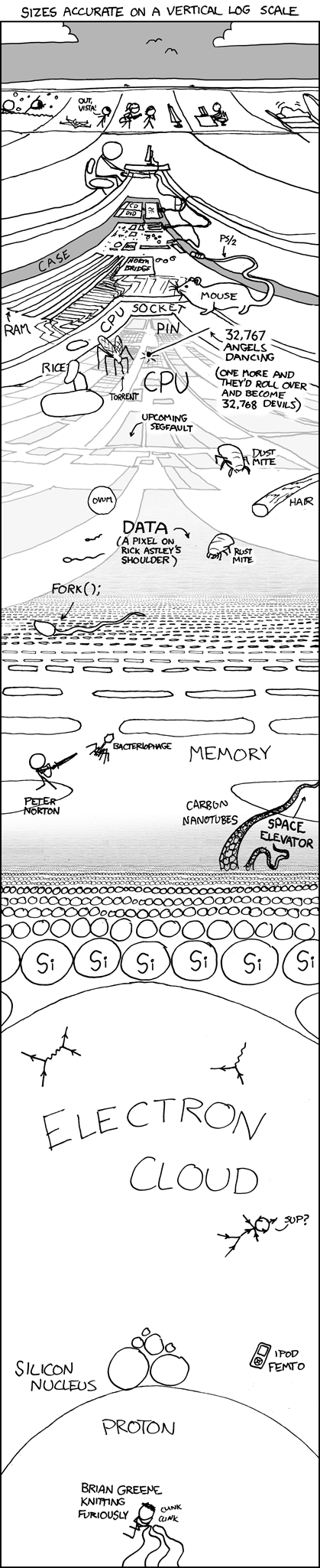

I also showed them pictures of the richter scale such as this one and students were intrigued and showed good understanding such as "Look, the Chile earth quake was about 10^3.5 times stronger than the Hiroshima bomb!". Music to my ears.

Then I introduced the laws of logarithms. I butchered that one. Check out Kate Nowak's recent post for a killer idea instead.
Next class, we looked at logarithmic functions. I started out by giving students a tiny review of inverses ("they undo each other, reflected around y=x, x and y are reversed") and then gave them this worksheet.
I really don't see the need to go into detail with log functions so I didn't.
Natural logarithm was introduced as inverse of natural exponential function and little else was done with it.
Test results were decent, no one treated logs as an object, and no one switched to the lower level. :)
Wednesday, December 8, 2010
Scratch
A friend today told me about Scratch as a possible fun and simplish move towards that Conrad Wolfram vision of computational math in schools. I'm currently too groggy from post-surgery morphine to dig in and create any teaching material using scratch right now. Has anyone used this for teaching yet?
Friday, November 26, 2010
Friday article summary - what is "good" teaching?
When Good Teaching Leads to Bad Results: The Disasters of "Well Taught" Mathematics Courses
Schoenfield, A. Educational Psychologist. (1988)
Schoenfield, A. Educational Psychologist. (1988)
Original article is available here.
Judging from how often I've come across people referring to this article, everybody but me must have read it long ago. Probably during teacher training? Teacher education in Sweden is ridiculous and at least mine did not include any research articles of any kind. So I read this article today for my own sake, just to figure out what it is everyone else is talking about.
Thursday, November 25, 2010
The Great Divide
An April post on Research in Practice caught my interest, and made it very clear what's been going on for me the last year and especially since I started daily reading all the great math teaching blogs out there:
There is a growing divide between my students' and mine perception of what good math teaching and learning looks like.
Simply put, I'm breaking the math-class contract.
Saturday, November 20, 2010
Teaching theories in psychology - how?
In my teaching of psychology, I am keen that my students should have knowledge and understanding of the science behind the concepts, models and theories that I ask them to learn. I do this by giving the students tons of research study summaries, and then ask them to use this research to back up whatever they are arguing in their essays. This is going very well. The students enjoy the studies, are getting very proficient at evaluating them critically, and are recognizing the need for scientific support for whatever claims they are making. Here is the problem: the students are not learning theories.
Friday article summary - concrete vs abstract?
The Advantage of Abstract Examples in Learning Math
Kaminsky, J. et al. Science. (2008)
When learning new mathematical concepts, for example the concept of mathematical groups of three objects, is it better to start with a concrete example or with a generic representation? This is the question Kaminsky and colleagues at Ohio State University investigated in their 2008 article.
Kaminsky, J. et al. Science. (2008)
When learning new mathematical concepts, for example the concept of mathematical groups of three objects, is it better to start with a concrete example or with a generic representation? This is the question Kaminsky and colleagues at Ohio State University investigated in their 2008 article.
Sunday, November 14, 2010
Time
Dan Meyer has his important ratio no. 1 which deals with the worth of instructional decisions as a ratio of instructional value and time expended in class (or out-of-class homework). It's student focused: the time expended is student time, and rightly Dan wants to maximize value per minute.
I think I need to develop my own important ratio, and it needs to deal with my time planning and evaluating lessons and student performance. It could go something like this:

I think I need to develop my own important ratio, and it needs to deal with my time planning and evaluating lessons and student performance. It could go something like this:

Subscribe to:
Posts (Atom)